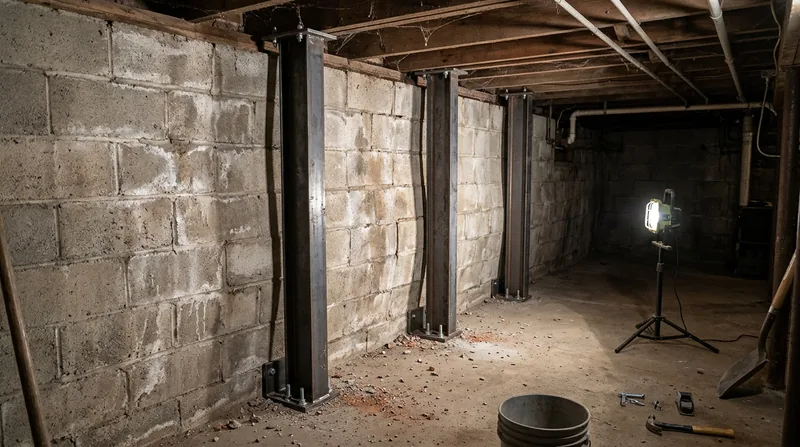




Bowing Wall Repair in Erie: When Lake Clay and Frost Push Back
If a foundation wall in your Erie home is leaning inward, cracking horizontally, or bulging at mid-height, you are looking at Bowing Wall Repair in Erie territory, and the cause is almost always outside the wall, not inside it. Erie sits on a flat lake plain of glacial clay, silt and sand where the water table stays high, and that saturated clay pushes laterally against older stone, rubble and early block walls every winter. Add deep frost and repeated freeze-thaw cycles, and a wall that looked plumb in October can show a visible bow by March. We stabilize bowing and leaning walls with carbon fiber straps, steel I-beams or wall anchors, matched to the severity of the movement and your soil. If you also see water at the wall base, start with our basement waterproofing service so the pressure source is addressed, not just the symptom.
Why Bowing Walls Are Common in Erie's Older Basements
Downtown, Little Italy and Sterrettania hold 1900s-1930s brick and frame two-story homes and foursquares with full basements of stone, rubble or early block. Those walls were never designed for the hydrostatic pressure that a high water table puts on them today, and many were parged on the inside, which hides the movement until a horizontal crack opens. Glenwood Park and the east side add 1930s-1950s bungalows and Cape Cods with partly finished basements where a bowing wall often shows up as a sticking door or a floor that has pulled away from the plate.
- Glacial clay soil holds water against the wall and does not drain freely, so hydrostatic pressure builds instead of releasing.
- Deep frost and freeze-thaw cycles push on the wall from the outside every winter and spring.
- Older stone and rubble walls have little tensile strength and bow before they crack.
- Block walls in 1950s-1970s Harborcreek and Millcreek ranches crack at the mortar joints when the footing settles.
- Bluff-top homes in Lawrence Park face undercutting of the lower wall where shoreline erosion removes support.
In every one of these cases, the fix is structural stabilization first and water management second, not the other way around.
Key info: A foursquare off West 26th Street in Erie showed a 2-inch bow at mid-height after spring melt. The wall was stone, the soil was saturated clay, and carbon fiber straps on the inside face stopped the movement without excavating the yard.
For the official position on structural permits, check the City of Erie building department before any wall stabilization work begins.
How We Repair a Bowing Wall in Erie, Step by Step
We start by reading the wall, not by selling a system. A bowing wall is a structural problem with a water cause, so we measure the deflection, map the cracks, check the footing and look at the soil and drainage on the outside before we recommend carbon fiber, steel or anchors. The method has to match the wall material and the severity, because a 1-inch bow in a block wall and a 3-inch bow in a rubble wall are two different jobs.
- We inspect the wall, footing and soil and document the deflection with measurements and photos.
- We identify the water source, whether it is hydrostatic pressure, a failed footing drain or grading that sends runoff to the wall.
- We recommend the right system: carbon fiber straps for moderate bowing, steel I-beams for heavier loads, wall anchors where the wall must be pulled back.
- We install the system and address the water with an interior perimeter drain or exterior membrane as needed.
- We verify the repair and walk you through what to watch for in the next freeze-thaw season.
If the water is the dominant problem, the structural repair is paired with drainage work, and our interior drain tile system is often the better answer than exterior excavation on a finished basement.
Key info: A 1960s brick ranch in Millcreek had a block wall bowing 1.5 inches with efflorescence along the base. Carbon fiber straps stabilized the wall, and a sump pump with a battery backup handled the water that was feeding the pressure.
Bowing Wall Repair Methods We Use in Erie
The right method depends on wall material, the amount of movement and how much lateral load the soil is applying. We match the system to the wall, not the other way around, and we tell you plainly when a simpler repair is enough.
| Approach | Description | Best for |
|---|---|---|
| Carbon fiber straps | Straps bonded to the inside face resist further inward movement. | Moderate bowing in block and poured walls |
| Steel I-beams | Vertical beams anchored to floor and joist resist heavy lateral loads. | Heavier bowing and rubble or stone walls |
| Wall anchors | Exterior plates and interior anchors pull the wall back toward plumb. | Walls that have moved but can be straightened |
| Epoxy or polyurethane injection | Fills and seals cracks that are not yet structural. | Hairline and shrinkage cracks with no bowing |
We confirm the choice after measuring the wall, and we never install a strap on a wall that needs anchors or beams.
Bowing Wall Repair Cost in Erie: What to Expect
Pricing for bowing wall repair starts from $600 for a limited crack and stabilization scope, but most real bowing jobs land well above that once straps, beams or anchors are involved. The number moves with wall length, the amount of deflection, wall material (rubble and stone cost more than block), access to the inside face, and whether drainage work is added. A finished basement in Fairview adds labor because the wall has to be exposed before it can be stabilized.
Get two or three estimates and ask each contractor to explain the method and the measurements behind it. A quote that does not mention deflection or soil is a guess, not a diagnosis. Our full pricing overview shows how we build the number.
Finding a Bowing Wall Repair Contractor Near Me in Erie
Hiring for structural wall work near Erie is different from hiring for a cosmetic repair, because the wrong method can make the movement worse. Ask for proof of licensing and insurance, get at least three written estimates, and call references on jobs done at least two winters ago so the freeze-thaw cycle has had a chance to test the work. Confirm who pulls the permit, since structural foundation repair commonly requires one and the rules vary by jurisdiction. Check any HOA requirements before exterior work, and ask how the contractor will protect the wall and the basement during the job.
Reach us through our contact page to set up a free basement inspection and a straight answer on whether your wall needs stabilization or just crack sealing.
Bowing Wall Repair in Erie: Pricing Guide
| Service | Price | Details |
|---|---|---|
| Crack injection and minor stabilization | Starting at $600 | Covers epoxy or polyurethane injection on non-structural cracks plus basic wall assessment and documentation. |
| Carbon fiber strap system | Starting at $1,800 | Includes straps bonded to the inside face; price moves with wall length and number of straps required. |
| Steel I-beam reinforcement | Starting at $2,800 | Vertical beams anchored to floor and joist; heavier loads and rubble walls push the number up. |
| Wall anchor system | On estimate | Exterior plates and interior anchors require an on-site look at soil, access and deflection before pricing. |
| Travel | Included | In Erie and surrounding areas, no separate call-out or mileage fee. |
| Estimate | Free | Response within 24h at (814) 990-9388, no obligation to book. |
Indicative pricing, the exact cost depends on square footage, finish, and site access. Free personalized estimate within 24h at (814) 990-9388.


