



French Drain Installation in Erie: Stop Water Before It Reaches Your Foundation
Erie sits on a flat lake plain of glacial clay, silt and sand, and that fine-grained soil holds water like a sponge. When the spring melt and summer storms arrive, runoff has nowhere to go but down along your foundation wall. That is why French Drain Installation in Erie is one of the most requested below-grade services we perform. We install exterior gravel-and-pipe systems that intercept groundwater before it touches the wall, with fabric wrap, correct slope, and a discharge to daylight or a sump basin. If you already see water in the basement after rain, start with a free basement inspection so we can confirm whether the source is surface runoff or hydrostatic pressure.
Why Erie Lots Flood Basements: Glacial Clay, High Water Table, and Freeze-Thaw
The city's older neighborhoods (Downtown, Little Italy, Sterrettania) sit on full basements built of stone, rubble or early block, and those walls were never designed for today's runoff volumes. In Glenwood Park and the east side, 1930s-1950s bungalows and Cape Cods have partly finished basements with shallow footing drains that are often crushed or silted shut. Out in Harborcreek and Millcreek, the 1950s-1970s brick ranches on poured or block lower levels face the same problem: the water table stays high and the soil will not drain fast enough during a heavy rain.
- Glacial clay soil sheds water slowly, so runoff ponds against the foundation instead of percolating away.
- Spring snowmelt and summer storms overwhelm undersized or clogged footing drains.
- Deep frost and freeze-thaw cycles open cracks that let surface water into the wall.
- Downspouts that dump next to the house concentrate water at the low corner of the lot.
When those conditions line up, a French drain along the foundation is the right tool because it catches the water before it builds hydrostatic pressure against the wall.
Key info: A Lawrence Park bluff-top home with stone and concrete walls can see the same saturated soil as a Fairview subdivision built in 2010. The bluff edge changes how water exits the lot, not whether the footing drain needs to work. We check both the wall and the discharge path before recommending a scope.
For the official view on drainage and discharge rules, the City of Erie's permitting office is the authority to check before any work alters how water leaves your property: City of Erie government site.
How We Install a French Drain on an Erie Foundation
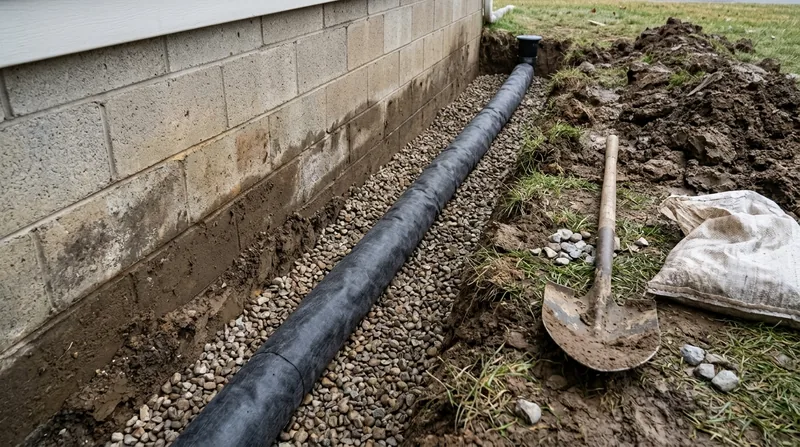
We do not guess at slope. On every job we start by mapping where the water actually goes during a storm, then we set the pipe grade so gravity does the work. The trench is lined with filter fabric, filled with washed gravel, and the perforated pipe is wrapped and backfilled so silt from the glacial clay cannot clog it. Where the lot is flat and daylight is not available, we tie the drain into a sump basin and pump it out through a discharge line with a check valve.
- We walk the lot and the basement to find the low corner, the wet wall, and the existing drain tile condition.
- We mark the trench line and confirm the discharge route (daylight, dry well, or sump basin) with you before digging.
- We excavate along the footing, install filter fabric, washed gravel and perforated pipe at the correct fall.
- We wrap the pipe, backfill in lifts, and restore grading so surface water still sheds away from the wall.
- We test the system with water and confirm the sump pump, check valve and discharge line are moving it out.
Every install ends with a water test, not a handshake, so you see the drain working before we leave.
Key info: On a 1950s brick ranch in Millcreek, the rear wall was wet every March but dry in July. The cause was a crushed footing drain under a concrete patio, not a wall crack. We ran a new exterior drain to daylight at the side yard and the March seepage stopped. A crack injection alone would have missed it.
If the inspection shows the wall itself is the path, we pair the drain with exterior basement waterproofing so the membrane and the drain work as one system.
French Drain Approaches We Use in Erie Homes
Not every lot gets the same drain. The table below shows the four approaches we install most often in Erie, and what each one is actually good at. We pick the approach from the site conditions, not from a sales script.
| Approach | Description | Best for |
|---|---|---|
| Exterior footing drain to daylight | Fabric-wrapped perforated pipe in washed gravel along the footing, sloped to a gravity outlet. | Lots with enough fall to reach a daylight outlet. |
| Exterior drain to sump basin | Same trench and pipe, but discharge collected in a basin and pumped out. | Flat lake-plain lots where gravity has nowhere to go. |
| Interior perimeter drain | Drain tile set inside the basement along the wall-floor joint, leading to a sump. | Finished basements and walls that cannot be excavated outside. |
| Surface and downspout correction | Regrading, downspout extensions and window well drains that move roof water away. | Homes where roof water is the main source of the wet corner. |
We will tell you plainly when a simple crack seal is enough and when the real problem is hydrostatic pressure that only a drain will solve.
French Drain Installation Cost in Erie: What to Expect
Most exterior French drain work in Erie starts at From $25/linear ft, and that figure is a starting point rather than a final number. The run length, the depth of the footing, the amount of concrete or patio that has to come out, and whether the discharge goes to daylight or to a sump basin all move the price. A short run on an open side yard in Fairview is a different job from a full perimeter on a Downtown stone foundation with a finished basement above it.
We give you a written scope before we dig, and we recommend getting two or three estimates on any drainage job so you can compare the pipe size, the gravel, the fabric and the discharge plan, not just the bottom line. For a fuller breakdown of how we price work, see our pricing overview.
Hiring a French Drain Contractor Near Me in Erie: What to Check
Any contractor can rent a trencher. What matters is whether they can read your lot and stand behind the work. Ask for proof of licensing and insurance before anyone touches the soil, and get at least two written estimates so you can compare the actual materials and discharge plan. Call references from jobs in your part of Erie, and ask the contractor to explain how they will keep silt out of the pipe and where the water will go when it leaves the trench.
Drainage work that alters how water leaves the property often needs a permit, and the rules vary by jurisdiction, so confirm the requirement with your local building department before work starts. If your neighborhood has an HOA, check its drainage and discharge rules as well. To set up a walkthrough, reach us through the contact page and we will schedule a free inspection.
Call (814) 990-9388 to get started.
French Drain Installation in Erie: Pricing Guide
| Service | Price | Details |
|---|---|---|
| Exterior French drain, per linear foot | From $25/linear ft | Includes filter fabric, washed gravel, perforated pipe and backfill along the footing. |
| Drain tied to sump basin and pump | From $1,800 | Adds basin, pump, check valve and discharge line where gravity daylight is not available. |
| Interior perimeter drain | From $35/linear ft | Drain tile set along the wall-floor joint for finished basements and walls that cannot be excavated. |
| Concrete or patio removal and restoration | On estimate | Price moves with slab thickness, patio size and access for equipment on tight Erie lots. |
| Travel | Included | in Erie and surrounding areas, no separate call-out or mileage fee. |
| Estimate | Free | Response within 24h at (814) 990-9388, no obligation to book. |
Indicative pricing, the exact cost depends on square footage, finish, and site access. Free personalized estimate within 24h at (814) 990-9388.


