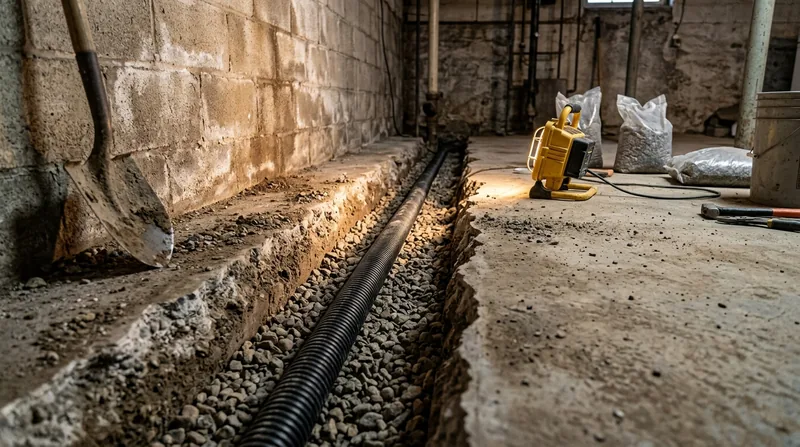




Erie sits on a flat lake plain of glacial clay, silt and sand, and that geology decides how a basement behaves. The water table climbs every spring, and the clay holds it against your footing instead of letting it drain away. In the 1900s to 1930s brick and frame homes of Downtown, Little Italy and Sterrettania, that pressure finds the stone and rubble walls first. In the 1950s to 1970s brick ranches of Harborcreek and Millcreek, it works on poured and block lower levels. An Interior Drain Tile System in Erie is the proven answer for this ground: we capture water at the footing, run it to a sump basin, and pump it out before it ever reaches your floor. We install it beneath the slab edge, so it works through any season, including the weeks when the ground is still frozen. If your basement takes on water each spring, start with a free basement inspection and we will tell you plainly what the water is doing.
Why the Lake Plain Makes Interior Drain Tile the Right Answer in Erie
Hydrostatic pressure is the whole story here. Glacial clay soil sheds water slowly, so spring melt and summer storms push runoff toward the low corner of the foundation, and the water table backs up under the slab. That is why so many Erie basements seep at the cove joint and leave efflorescence on the block. Exterior excavation can work, but on a flat lot with a high water table, interior perimeter drain gets the water at the footing without digging up the yard.
- Stone and rubble wall basements in Sterrettania and Little Italy leak at the mortar joints when the water table rises.
- Poured and block ranches in Millcreek and Harborcreek crack at the cove joint as the freeze-thaw cycle moves the wall each winter.
- Bluff-top homes in Lawrence Park face undercutting at the lower wall where shoreline erosion meets the footing.
- 1990s to 2020s subdivisions in Fairview and Edinboro still get wet floors when the sump pump fails or the discharge line freezes.
When the pattern is water rising through the floor and not just a single wall crack, interior drain tile is the correct repair, and a crack alone calls for injection instead.
Key info: A Glenwood Park bungalow that puddles at the floor drain every March is showing rising water table, not a wall crack. We scope that as interior perimeter drain and a sump basin, not a tube of sealant. Permits for work that alters drainage or the sanitary connection of a sump discharge are handled through the City of Erie building department, and rules vary, so verify before scheduling: City of Erie.
How We Install an Interior Drain Tile System in Erie
We start by reading the water, not the wall. The inspection maps where seepage enters, how the floor slopes, and where the existing footing drain or weeping tile sits, then we set the sump basin at the lowest point. We break out a channel along the slab edge, lay perforated pipe in washed stone, and tie it into the basin. The system stays inside, so we work through Erie winters and spring melt without waiting on the ground to thaw.
- We walk the basement, check for efflorescence, and confirm the water is coming from below and not from a downspout or grading issue.
- We cut a perimeter channel at the slab edge and remove the old floor material down to the footing.
- We set the sump basin at the low corner and bed perforated drain tile in washed stone around the perimeter.
- We connect the discharge line, install a check valve, and route the outflow away from the foundation.
- We pour new concrete over the channel and test the pump with water before we leave.
Every install ends with a wet test, because a system that has not moved water is not finished.
Key info: In a Harborcreek ranch with a partly finished basement, we cut the channel, set the basin at the low corner, and tied a battery backup sump pump into the same pit. That matters when a summer storm knocks out power, which is exactly when a wet basement gets worse.
Interior Drain Tile vs. Other Approaches in Erie Homes
Not every wet basement needs the same repair, and we say so on the estimate. A single vertical crack that seeps after rain is a job for epoxy or polyurethane injection. Water rising across the whole floor is a drain tile job. The table below shows where each approach fits in Erie housing stock.
| Approach | Description | Best for |
|---|---|---|
| Interior perimeter drain tile | Perforated pipe at the footing inside the slab edge, draining to a sump basin and pump. | Rising water table and floor seepage on the lake plain. |
| Exterior footing drain | Weeping tile and membrane along the outside of the footing, with regrading. | Wall seepage high on the wall and yard drainage problems. |
| Epoxy or polyurethane injection | Injection ports seal a single crack from the inside. | A defined vertical crack in a poured wall, not a water table problem. |
| Drain tile repair and replacement | Clearing or replacing a collapsed or silted existing footing drain. | Older homes where the original weeping tile has failed. |
If the diagnosis points to an existing drain that has failed, we quote a drain tile repair instead of a new system.
Interior Drain Tile System Cost in Erie: What to Expect
Interior drain tile pricing in Erie starts at From $50 per linear foot, and that figure covers the channel, the perforated pipe, the stone bed, and the concrete patch. The basin, pump, and discharge line are quoted as part of the job once we see the layout. Most full-perimeter basements land in a range you can plan around, and a single-wall or partial run costs less.
- Perimeter length drives the number most, since the pipe and channel are priced by the foot.
- Slab thickness and whether the floor is finished add labor, because we cut and restore more concrete.
- Sump basin, pump, and discharge routing are quoted separately from the linear footage.
- Access matters: a narrow stairwell in a Sterrettania foursquare slows the work compared to a wide ranch basement in Millcreek.
Get two or three estimates and compare scope, not just the total, because a low bid that skips the stone bed or the check valve is not the same job. Our full breakdown is on the pricing page.
Choosing a Waterproofing Contractor Near Me in Erie
Ask three questions before anyone cuts your floor. First, are they licensed and insured, and will they show a certificate. Second, do they diagnose the water source or just quote a system. Third, do they pull the permit when the work alters drainage or the sump discharge connection, because the City of Erie building department decides that and rules vary. A contractor who cannot answer all three is not the one for your basement.
- Ask for references from homes with the same wall type, stone, block, or poured, since the repair differs.
- Confirm the warranty is transferable and get it in writing before work starts.
- Check that the discharge line will be routed away from the foundation, not dumped at the wall.
We will tell you when a simple crack seal is enough and when the real problem is hydrostatic pressure, because an honest diagnosis saves you money. Reach out through our contact page to schedule.
Interior Drain Tile System in Erie: Pricing Guide
| Service | Price | Details |
|---|---|---|
| Full perimeter interior drain tile | Starting at $50/linear ft | Covers channel, perforated pipe, washed stone bed, and concrete patch per linear foot |
| Partial run or single wall | Starting at $50/linear ft | Shorter runs cost less overall; priced by the foot with same materials |
| Sump basin and pump package | Quoted with the job | Basin, pump, check valve, and discharge routing priced separately from linear footage |
| Finished basement restoration | On estimate | Thicker slab and finished floors add cutting and concrete restoration labor |
| Travel | Included | in Erie and surrounding areas, no separate call-out or mileage fee |
| Estimate | Free | Response within 24h at (814) 990-9388, no obligation to book |
Indicative pricing, the exact cost depends on square footage, finish, and site access. Free personalized estimate within 24h at (814) 990-9388.


